
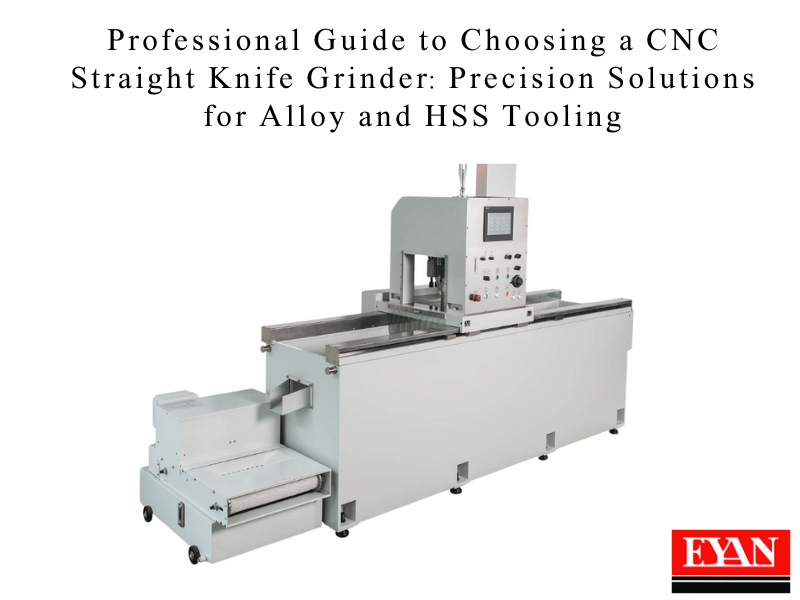
1. Based on Tool Material: Different Grinding Requirements
Alloy Steel Knife Grinding
Alloy steel tools are highly tough and wear-resistant. Grinding these tools requires high-hardness SDC grinding wheels to cope with the material’s hardness, combined with a stable automatic feed system to avoid overheating and microcracks.
Application Example: Woodworking planer knives and plastic granulator blades—if grinding angles are inaccurate, edges may burn or produce uneven cuts.
HSS Knife Grinding
HSS knives are designed for high-speed rotation and demand extremely precise edge angles and finish. Therefore, the grinder should support micro beveling and mirror polishing functions.
Application Example: Printing slitting knives and paper cutters must maintain high sharpness and low friction to avoid frayed paper edges or tearing.
2. Based on Application Industry: Each Sector Has Specific Needs
| Industry | Common Knife Types | Grinding Requirements |
|---|---|---|
| Woodworking | Planer knives, chipper blades | Sharp edges, burr-free cuts, precise angle control |
| Plastics | Granulator knives, shredder blades | Heat resistance, cooling systems, anti-deformation design |
| Printing & Packaging | Paper cutters, film slitters | Mirror-finished edges, consistent and continuous cutting |
| Machine Tool / Molds | Alloy cutting tools | High-precision control, reduced thermal stress and warping |
3. Based on Grinding Method: Precision vs. Cost
| Type | Features | Recommended Use Case |
|---|---|---|
| Manual Grinders | Low cost, requires skilled operators | Repair shops, small-scale users |
| Semi-Automatic | Adjustable parameters, still needs manual setup | Small to mid-size factories, blade maintenance |
| CNC Grinders | Auto-feed, precise angle and speed control | Mass blade production and multi-material grinding |
Practical Difference: Manual grinders often lack consistency in angles and accuracy, making them unsuitable for high-volume or multi-material demands. CNC grinders use parameter-based workflows to standardize sharpening quality.
4. Based on Precision and Production Capacity
- Small Repair Shops: Prioritize flexibility and quick turnaround, low need for automation.
- Medium Factories: Must balance productivity and quality; need support for multiple knife types and fast setup.
- Large Tool Centers / Manufacturers: Rely on repeatable precision (±0.005mm) and automation. CNC grinders are core to operations.
5. Based on Functionality and Expandability
Basic Functions
- Precision grinding of main angles and clearance surfaces
- Switchable rough and fine grinding modes
Advanced Functions
- Micro bevel grinding
- Mirror polishing of HSS blades
- Spark-free grinding mode
System & Structure Support
- Replaceable SDC grinding wheels
- Cooling system and mist collection
- Fully enclosed safety housing
- CNC servo-controlled feed and auto angle adjustment
Conclusion
Facing modern cutting tool challenges, choosing the right straight knife grinder means more than improving edge quality—it directly affects your production efficiency, yield rate, and long-term competitiveness.
Want to learn more about industrial grinding solutions? Contact EYAN today to explore the right machine for your needs.